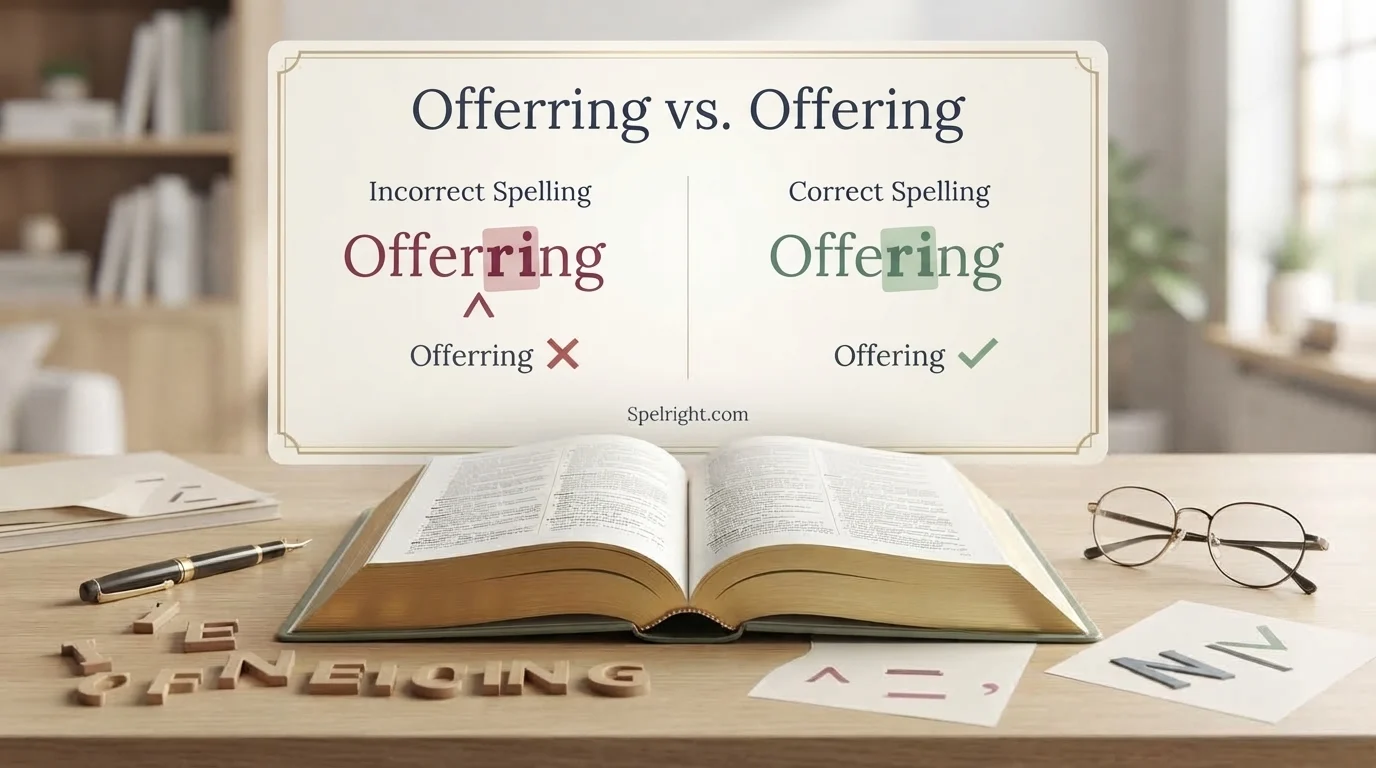
If you are confused about offerring vs. offering, the correct spelling is offering. Offerring is a common spelling mistake and is not the standard English spelling. The word offering comes from the verb offer, which means to give, provide, or present something to someone. For example, “The company is offering free delivery.”
The confusion usually happens because some English words double their final consonant when a suffix is added. However, offer already ends with two consonants, f + f, so another r is not added. The correct form is always offering, with only one r after the double “f”: o-f-f-e-r-i-n-g.
Quick Answer
Offering is the correct spelling. Offerring is incorrect. The word offering is the -ing form of offer and can mean giving, providing, presenting, or something that is available for people to accept or buy. Always write offering, not offerring.
Why Do People Confuse Offerring and Offering?
People often confuse these spellings because English spelling rules sometimes require a final consonant to be doubled before adding -ing.
For example:
- run → running
- sit → sitting
- begin → beginning
Because offer already contains a double f, some writers mistakenly think another consonant should be doubled when adding -ing.
But that does not happen here.
The correct spelling is:
offer + ing = offering
Not:
offer + ing = offerring
The extra r in “offerring” is unnecessary.
What Is the Correct Spelling: Offering or Offerring?
The correct spelling is offering.
Offering can be used as a noun or as the present participle of the verb offer.
As a verb form:
- The store is offering a discount.
- She is offering to help.
- They are offering several options.
As a noun:
- The company has a new product offering.
- His offering was accepted.
- The restaurant has a wide range of food offerings.
Offerring is a misspelling and should be avoided in standard English.
First Word: Offerring
Offerring is an incorrect spelling.
It is usually created by adding an unnecessary r to the word offer before adding -ing.
Incorrect:
- offerring
- The company is offerring a discount.
Correct:
- offering
- The company is offering a discount.
If you see offerring in writing, it should normally be corrected to offering.
Second Word: Offering
Offering is the correct English spelling.
It is formed from the verb offer by adding -ing:
offer + ing = offering
The word can have several related meanings depending on the sentence.
Offering as a verb
It can mean giving or providing something.
- The company is offering free shipping.
- She is offering advice.
- They are offering several services.
Offering as a noun
It can mean something that is given, provided, presented, or made available.
- The store introduced a new product offering.
- The company expanded its service offerings.
- The charity received several generous offerings.
Offerring vs. Offering: Comparison Table
| Word | Correct? | Meaning | Example |
| Offerring | ❌ No | Incorrect spelling | The company is offerring discounts. |
| Offering | ✅ Yes | Giving, providing, or presenting something | The company is offering discounts. |
The key difference is simple: offering has only one r after the double f.
When Should You Use Offering?
Use offering whenever you need the -ing form of offer or when you are using offering as a noun.
Use “offering” as a verb
When someone is currently giving, providing, or suggesting something:
- The teacher is offering extra help.
- The company is offering a new service.
- He is offering his support.
Use “offering” as a noun
When referring to something provided, presented, or made available:
- This is the company’s newest product offering.
- The university has several course offerings.
- Customers can choose from different service offerings.
10+ Examples of Offering
Here are some simple examples to help you remember the correct spelling:
- The store is offering a special discount.
- She is offering me some helpful advice.
- The company is offering free delivery.
- He is offering to drive us home.
- They are offering several payment options.
- The school is offering extra classes this summer.
- We appreciate your offering of help.
- The restaurant has a wide range of food offerings.
- This company has an attractive service offering.
- The website is offering useful information.
- She kept offering suggestions during the meeting.
- The new product offering is designed for beginners.
Notice that every example uses offering, never offerring.
Common Mistakes
The most common mistake is adding an extra r.
Incorrect
The company is offerring a new service.
Correct
The company is offering a new service.
Another common mistake is thinking that every word must double its final consonant before -ing.
English does not work that way. The spelling of each word needs to be considered individually.
Here are some examples:
- offer → offering
- open → opening
- visit → visiting
- run → running
- stop → stopping
The spelling pattern depends on the word and its ending.
Memory Trick
A simple way to remember the spelling is:
OFFER + ING = OFFERING
Do not add another R.
Think:
Offer has two Fs, but offering does not need three Rs.
You can also remember the spelling visually:
O F F E R I N G
There is only one R between the E and I.
American vs. British English
There is no spelling difference between American and British English for this word.
Both varieties use:
offering
Examples:
- American English: The company is offering a discount.
- British English: The company is offering a discount.
The incorrect spelling offerring is not the standard form in either variety.
Similar Words
Understanding related forms can make the spelling easier to remember.
Offer
Offer is the base verb.
- I want to offer you some advice.
Offers
Offers is the third-person singular form or plural noun.
- The company offers free delivery.
- We received several offers.
Offered
Offered is the past tense and past participle.
- She offered to help me.
Offering
Offering is the -ing form.
- She is offering to help me.
Offerings
Offerings is the plural noun.
- The company has several service offerings.
What Is the Main Difference Between Offerring and Offering?
The main difference is spelling and correctness.
Offering is the standard English word, while offerring is a misspelling.
The correct spelling follows this pattern:
offer + ing → offering
There is no need to add another r.
Final Verdict
Offering is correct.
Offerring is incorrect.
If you are writing an email, essay, article, school assignment, business document, or professional message, always use offering.
The easiest rule to remember is:
Offer + ing = offering.
Frequently Asked Questions
Is “offerring” a correct word?
No. Offerring is not the standard spelling. The correct spelling is offering.
Is it “offering” or “offerring”?
The correct form is offering, with only one r after the double f.
Why is “offerring” wrong?
“Offerring” contains an unnecessary extra r. The correct formation is offer + ing = offering.
How do you spell offering?
The correct spelling is:
O-F-F-E-R-I-N-G
Is offering the present participle of offer?
Yes. Offering is the present participle and -ing form of the verb offer.
For example:
She is offering to help.
Is “offering” also a noun?
Yes. Offering can be a noun referring to something that is given, provided, presented, or made available.
For example:
The company introduced a new service offering.
Is the spelling “offering” the same in American and British English?
Yes. Both American and British English use offering.
Remember This
- ✅ Offering = correct
- ❌ Offerring = incorrect
- Offer + ing = offering
- Do not add another r.
- American and British English both use offering.
Conclusion
The confusion between offerring vs. offering is mainly caused by the way English spelling changes when words take the -ing ending. While some words double a final consonant, offer does not need an additional r. The correct form is simply offering.
if you mean giving, providing, presenting, or making something available, use offering. if you are writing for school, work, business, or everyday communication, remembering offer + ing = offering will help you avoid this common spelling mistake.