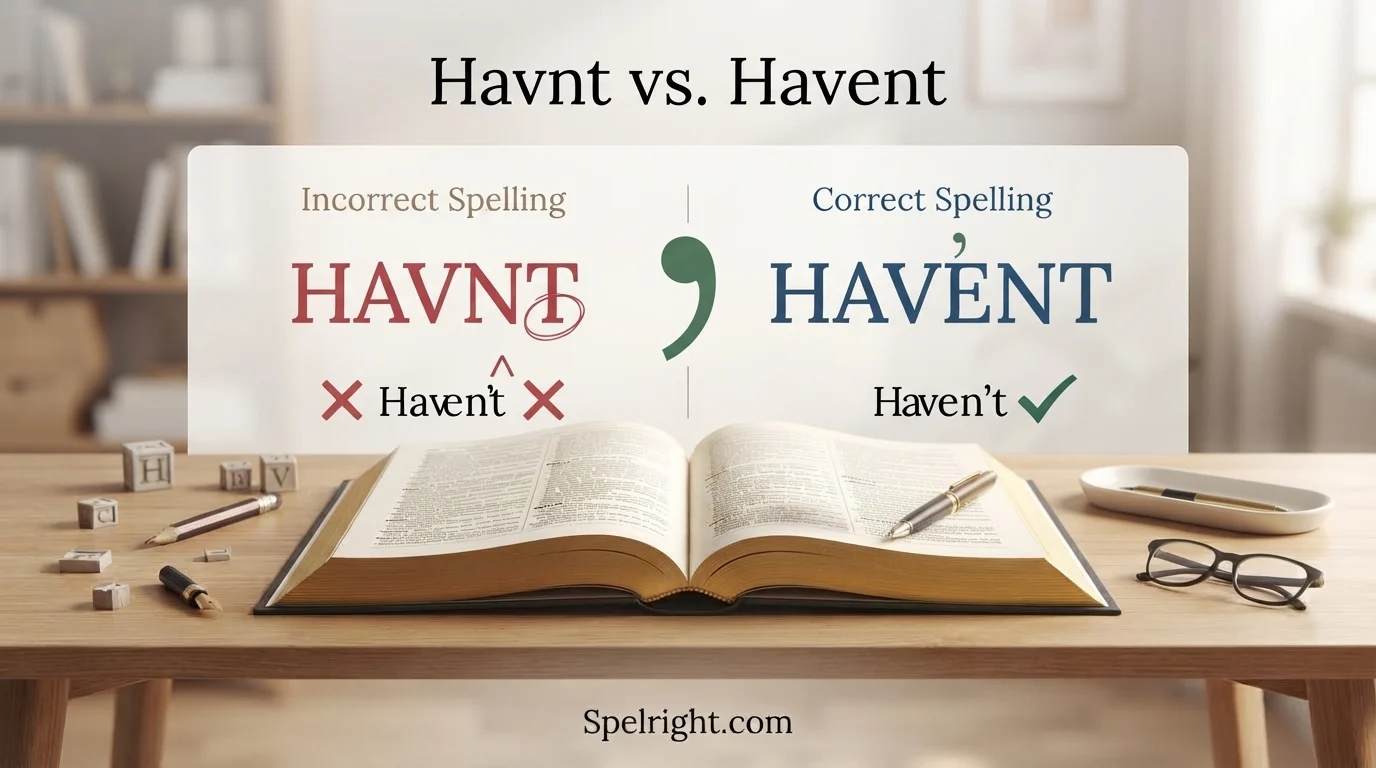
If you are confused about havnt vs. havent, you are not alone. Both forms are often seen in quick texts, social media posts, and informal writing. However, neither havnt nor havent is the standard spelling of the English contraction. The correct form is haven’t, with an apostrophe.
Haven’t is the short form of have not. It is commonly used when talking about something that has not happened or something a person has not done. For example, “I haven’t finished my homework” means “I have not finished my homework.”
Understanding this small spelling difference can help you write more clearly and correctly. In this guide, we will explain havnt vs. havent, why both forms can appear online, when to use haven’t, and how to remember the correct spelling easily.
Quick Answer
Haven’t is the correct standard spelling. Havnt is an incorrect spelling because it leaves out the e, while havent is usually written without the apostrophe. The standard contraction of have not is haven’t. Use haven’t in normal English writing, including sentences such as “I haven’t seen him.”
Why Do People Confuse Havnt and Havent?
The confusion happens mainly because people type quickly, especially in text messages and online conversations.
When people write haven’t, they may accidentally leave out the apostrophe and write havent. Others may type havnt, removing both the apostrophe and the letter e.
The pronunciation can also make the spelling less obvious. In everyday speech, haven’t can sound quite quick, so learners may not immediately recognize how it should be written.
The important point is simple:
- havnt ❌ Incorrect
- havent ❌ Nonstandard spelling
- haven’t ✅ Correct
- have not ✅ Correct full form
First Word: Havnt
Havnt is not a standard English word.
It is usually an informal misspelling of haven’t. The writer has removed the apostrophe and also left out the letter e.
For example:
- ❌ I havnt finished.
- ❌ We havnt arrived.
- ❌ They havnt called.
The correct versions are:
- ✅ I haven’t finished.
- ✅ We haven’t arrived.
- ✅ They haven’t called.
You should avoid havnt in school assignments, professional emails, formal writing, and other situations where correct spelling matters.
Second Word: Havent
Havent is also not the standard spelling.
It is usually an attempt to write haven’t without the apostrophe. The letters are otherwise close to the correct form, but the apostrophe is important in a standard contraction.
For example:
- ❌ I havent eaten yet.
- ❌ She havent finished.
- ❌ We havent seen it.
Correct examples include:
- ✅ I haven’t eaten yet.
- ✅ She hasn’t finished.
- ✅ We haven’t seen it.
Remember that haven’t is made from:
have + not → haven’t
The apostrophe shows that letters have been omitted.
Havnt vs. Havent: Comparison Table
| Form | Correct? | Meaning | Standard English? |
| havnt | ❌ No | Intended to mean “have not” | No |
| havent | ❌ No | Intended to mean “have not” | No |
| haven’t | ✅ Yes | Short form of “have not” | Yes |
| have not | ✅ Yes | Full form | Yes |
When Should You Use Each?
There is really only one standard contraction you should use: haven’t.
Use “haven’t” in normal writing
Use haven’t when you want to shorten have not.
Examples:
- I haven’t finished the book.
- We haven’t decided yet.
- They haven’t arrived.
- You haven’t answered my question.
Use “have not” for the full form
You can use have not when you want to write the complete form.
For example:
- I have not finished the book.
- We have not decided yet.
- They have not arrived.
The full form can sound more formal or emphatic depending on the sentence.
Avoid “havnt” and “havent”
Although you may see these spellings in informal online communication, they are not the standard written forms.
For correct English, write haven’t.
10+ Examples of Haven’t
Here are some simple examples to help you understand how haven’t works.
- I haven’t eaten breakfast yet.
- We haven’t finished our homework.
- They haven’t arrived at the airport.
- I haven’t seen that movie.
- You haven’t told me the answer.
- We haven’t visited London before.
- I haven’t spoken to her today.
- They haven’t completed the project.
- You haven’t cleaned your room.
- I haven’t received your message.
- We haven’t made a final decision.
- They haven’t called us yet.
In every example, haven’t means have not.
For example:
I haven’t seen that movie.
means:
I have not seen that movie.
Common Mistakes
One common mistake is writing havnt instead of haven’t.
- ❌ I havnt finished.
- ✅ I haven’t finished.
Another mistake is leaving out the apostrophe:
- ❌ We havent arrived.
- ✅ We haven’t arrived.
You should also remember that haven’t normally goes with I, you, we, and they.
For example:
- I haven’t finished.
- You haven’t finished.
- We haven’t finished.
- They haven’t finished.
With he, she, and it, the usual contraction is hasn’t, not haven’t.
- ❌ She haven’t finished.
- ✅ She hasn’t finished.
Memory Trick
A simple way to remember the spelling is:
HAVE + NOT = HAVEN’T
Think of the word have first. Then remove the e and add the apostrophe before t:
have not → haven’t
So remember:
HAVEN’T = HAVE NOT
If you see havnt, notice that the e is missing.
If you see havent, notice that the apostrophe is missing.
The correct form has both the e and the apostrophe:
haven’t ✅
American vs. British English
There is no major spelling difference between American and British English when it comes to haven’t.
Both varieties use:
haven’t
For example:
- American English: I haven’t finished yet.
- British English: I haven’t finished yet.
The contraction is standard in both forms of English.
The main issue is not whether you are using American or British English. The important thing is to use the standard spelling haven’t rather than havnt or havent.
Similar Words
Several English contractions follow a similar pattern.
| Full Form | Correct Contraction |
| have not | haven’t |
| has not | hasn’t |
| had not | hadn’t |
| do not | don’t |
| does not | doesn’t |
| did not | didn’t |
| cannot | can’t |
| will not | won’t |
These contractions use apostrophes to show that letters have been omitted.
For example:
has not → hasn’t
had not → hadn’t
do not → don’t
have not → haven’t
Final Verdict
The correct standard spelling is haven’t.
Havnt is an incorrect spelling because it leaves out the e and the apostrophe. Havent is also not the standard written form because it leaves out the apostrophe.
When you mean have not, use haven’t.
Correct:
I haven’t finished my work.
Incorrect:
I havnt finished my work.
Nonstandard:
I havent finished my work.
For clear and correct English, choose haven’t.
Frequently Asked Questions
Is “havnt” a correct word?
No. Havnt is not the standard spelling of any English word. It is usually a misspelling of haven’t.
Is “havent” correct without an apostrophe?
No. The standard contraction is haven’t, with an apostrophe. In casual digital communication, people sometimes omit apostrophes, but havent is not the standard spelling.
What is the correct spelling of havnt?
The correct spelling is haven’t. It is the contraction of have not.
What does “haven’t” mean?
Haven’t means have not. For example, “I haven’t eaten” means “I have not eaten.”
Can I use “haven’t” in formal writing?
Yes, haven’t is a standard English contraction. However, depending on the style and level of formality, you may sometimes choose the full form have not.
Is “haven’t” American or British English?
Haven’t is used in both American and British English. The spelling is the same in both varieties.
Why does “haven’t” have an apostrophe?
The apostrophe shows that letters have been left out when have not is shortened to haven’t.
Remember This
Havnt ❌
Havent ❌
Haven’t ✅
The correct contraction of have not is haven’t. Keep the e from have and use an apostrophe before t.
Have not → Haven’t
That one small pattern will help you avoid both common spelling mistakes.
Conclusion
When comparing havnt vs. havent, neither form is the standard spelling. The correct English contraction is haven’t, which means have not. The apostrophe is important because it shows that letters have been removed from the original phrase.
If you are writing a school assignment, email, article, message, or any other standard English text, choose haven’t. Once you remember have not → haven’t, the difference becomes easy to remember.











4 thoughts on “Havnt vs. Havent: Why “Haven’t” Is the Correct Form.”