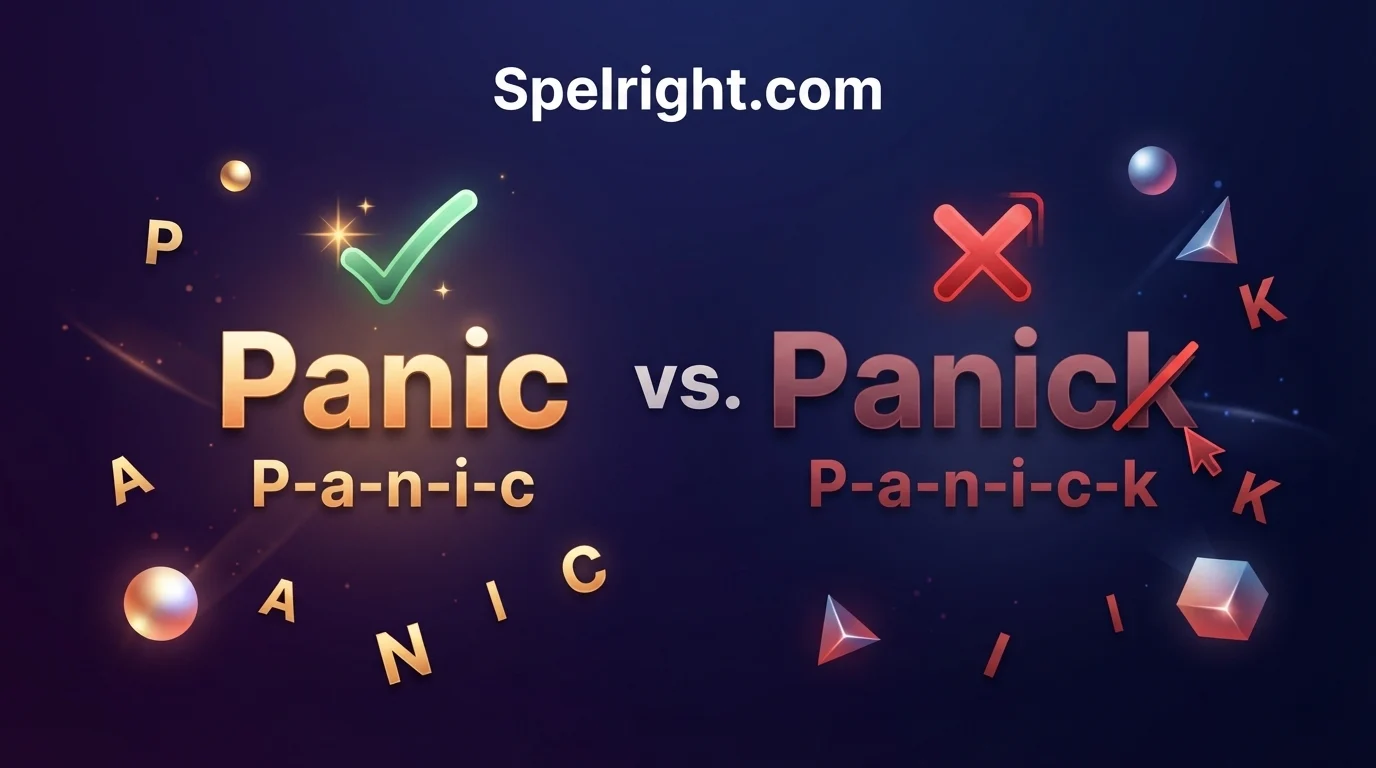
When writing about fear, sudden worry, or a strong feeling of anxiety, many people wonder if the correct spelling is panic or panick. The correct spelling is panic. Panick is a misspelling and is not used as the standard spelling in English.
The word panic can be used as a noun, verb, or adjective-related form in expressions such as panic attack, panic button, and panic quickly. Its past tense is panicked, and its present participle is panicking. Understanding these forms is important because the spelling changes when certain endings are added. This guide explains the difference between panic vs. panick, shows how to use the correct word in everyday sentences, and explains common mistakes that learners often make.
Quick Answer
Panic is the correct spelling. Panick is incorrect in standard English. Use panic when referring to sudden fear, worry, or a loss of calm. When adding endings, the correct forms are panicked and panicking, not panicked with an extra k or panicking with two k’s.
Why Do People Confuse “Panic” and “Panick”?
The confusion usually happens because many English verbs add -k before certain endings. For example, panic ends with a c sound, so learners may think that an extra k is needed.
However, the base verb is simply panic.
When endings are added, English spelling rules change the final c to ck before -ed or -ing:
- panic → panicked
- panic → panicking
This is why panick is not the correct base form.
What Does “Panic” Mean?
Panic is the correct word for a sudden feeling of extreme fear, worry, or loss of control.
It can be used as both a noun and a verb.
Panic as a noun
As a noun, panic means a sudden and strong feeling of fear or anxiety.
Example:
There was a sense of panic when the lights suddenly went out.
Panic as a verb
As a verb, panic means to become very frightened or worried and have difficulty thinking calmly.
Example:
Try not to panic if you make a small mistake.
What Does “Panick” Mean?
Panick is not the standard English spelling of the word.
If you want to describe sudden fear or extreme worry, use panic.
❌ I started to panick when I lost my phone.
✅ I started to panic when I lost my phone.
The spelling panick should generally be corrected to panic.
Panic vs. Panick: Comparison Table
| Word | Correct? | Meaning | Example |
| Panic | ✅ Yes | Sudden fear or extreme worry | Don’t panic. |
| Panick | ❌ No | Incorrect spelling | Don’t panick. |
When Should You Use “Panic”?
Use panic when you are talking about:
- sudden fear
- extreme worry
- a loss of calm
- an emergency reaction
- becoming very frightened
- feeling unable to think clearly because of fear
Common expressions with “panic”
- panic attack
- panic button
- panic mode
- panic buying
- panic reaction
- panic situation
- panic easily
- don’t panic
10+ Examples of “Panic”
- Don’t panic; everything will be fine.
- She began to panic when she could not find her keys.
- There was widespread panic after the announcement.
- Try to stay calm and do not panic.
- He tends to panic before important exams.
- The passengers started to panic when the alarm sounded.
- She felt a sudden wave of panic.
- The teacher told the students not to panic.
- I almost panicked when I saw the broken window.
- He was panicking because he was running late.
- The sudden noise caused panic among the crowd.
- You should not panic over a small mistake.
Common Mistakes
One of the most common mistakes is adding k to the end of the base word.
❌ Panick
✅ Panic
Another common mistake is misunderstanding the forms created when suffixes are added.
Correct forms include:
- panic
- panics
- panicked
- panicking
Examples:
❌ She panicked when she heard the news.
✅ She panicked when she heard the news.
❌ He is panicing about the exam.
✅ He is panicking about the exam.
Memory Trick
Remember:
Panic ends with C.
Think of the phrase “Calm down, don’t panic.”
The base word is always panic, with c at the end.
When adding -ed or -ing, the spelling changes:
panic → panicked → panicking
American vs. British English
There is no standard American/British spelling difference between panic and panick.
Both American and British English use:
- panic
- panicked
- panicking
Panick is not the standard spelling in either variety.
Similar Words
Depending on the context, words related to panic include:
- fear
- fright
- anxiety
- alarm
- worry
- nervousness
- distress
- terror
- concern
These words are related but do not always have exactly the same meaning.
For example, worry can describe ongoing concern, while panic usually suggests a sudden and intense reaction.
Final Verdict
Panic is the correct spelling, while panick is incorrect in standard English.
If you are writing about sudden fear, extreme worry, or losing your calm, use panic. Remember that the related forms are panicked and panicking.
FAQs:
Is “panick” a correct spelling?
No. Panick is not the standard spelling. The correct spelling is panic.
Is it “panic” or “panick”?
The correct word is panic. There is no extra k at the end of the base word.
How do you spell “panicked”?
The correct spelling is panicked. It is formed from panic + -ed.
Is “panicking” spelled with one or two k’s?
The correct spelling is panicking, with two k’s before the ending -ing.
What is the past tense of panic?
The past tense is panicked.
Example: She panicked when she could not find her passport.
What is the present participle of panic?
The present participle is panicking.
Example: He is panicking about the upcoming test.
Is “panic” a noun or a verb?
Panic can be both a noun and a verb.
As a noun: She felt panic.
As a verb: She began to panic.
Why is “panick” wrong?
Panic is the established standard spelling of the word. Adding k to create panick is an unnecessary spelling change.
Remember This
Panic = correct ✅
Panick = incorrect ❌
The correct forms are:
panic → panics → panicked → panicking
Conclusion
The difference between panic vs. panick is simple: panic is the correct English spelling, while panick is a misspelling. Use panic when describing sudden fear, extreme worry, or a loss of calm.
It is also useful to remember the related forms panicked and panicking. Once you remember that the base word ends in c, you can avoid this common spelling mistake and use the word confidently in everyday English.