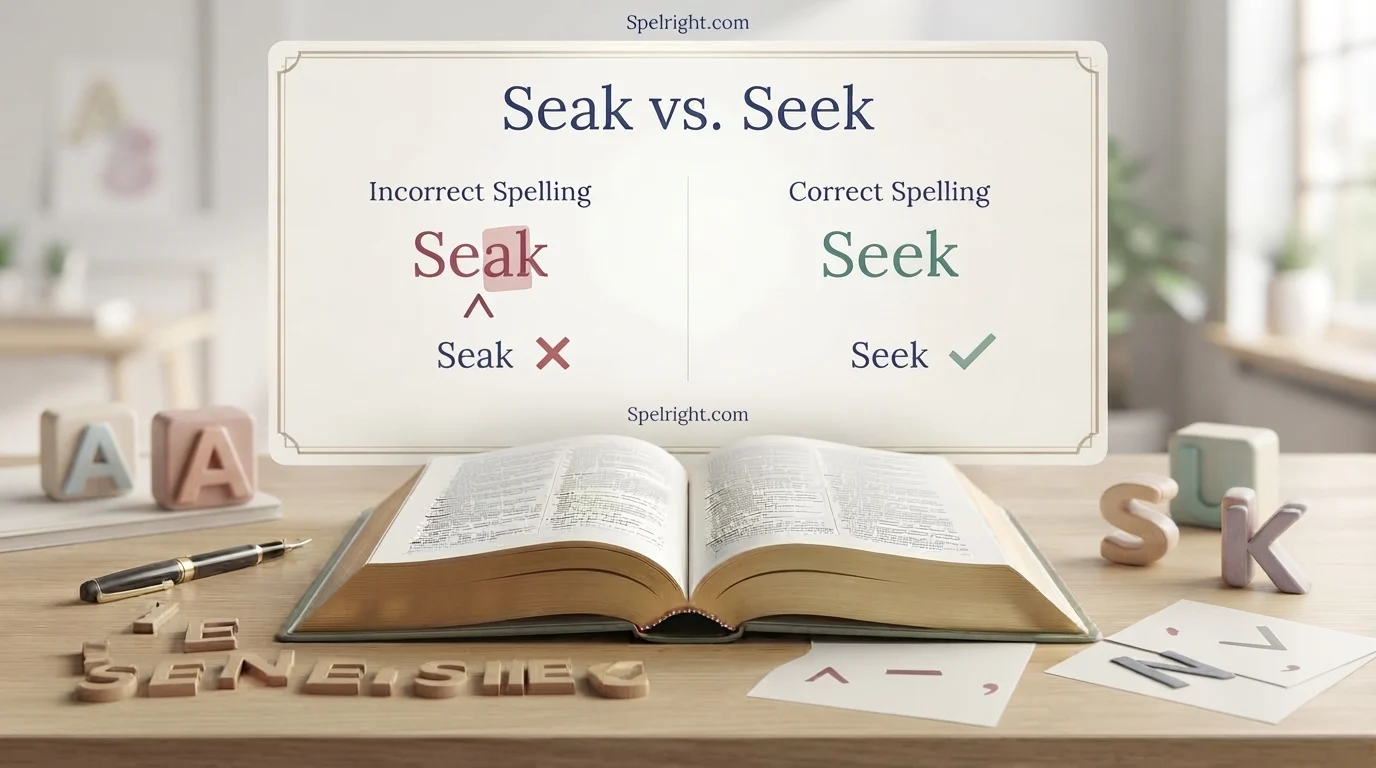
Many English learners confuse seak and seek because they sound similar when spoken quickly. However, these two spellings do not have the same status in standard English. If you want to express the idea of looking for, trying to find, or asking for something, seek is the correct word. Seak is generally a misspelling of seek, not the standard spelling of the verb.
Understanding this difference is useful for students, writers, and anyone who wants to improve their English spelling. The good news is that the correct choice is simple: when you mean “look for” or “try to find,” use seek. This article explains the difference between seak and seek, shows how to use seek correctly, and provides practical examples to help you remember the spelling.
Quick Answer
Seek is the correct standard English word when you mean “to look for,” “try to find,” or “ask for.” Seak is usually a misspelling of seek. For example, “I seek advice” is correct, while “I seak advice” is incorrect.
Why Do People Confuse Seak and Seek?
People often confuse seak and seek because they are pronounced similarly and differ by only one letter.
The main problem is the vowel combination “ea.” English has many words where vowel patterns can be difficult to remember. Learners may write seak because they hear a long “ee” sound and are unsure which spelling to use.
The correct spelling is:
- Seek ✅
- Seak ❌
What Does “Seek” Mean?
Seek is a verb that means to look for, search for, try to find, or try to obtain something.
It can also mean asking for something, such as help, advice, information, or permission.
Examples of Seek
- I seek advice from my teacher.
- She is seeking a new job.
- They went to seek help.
- We should seek more information.
- He sought an answer to the problem.
The past tense of seek is sought, not seeked.
What Does “Seak” Mean?
Seak is not the standard spelling of the common English verb meaning “to look for” or “try to find.”
If you want to express that meaning, use seek.
For example:
- ❌ I want to seak help.
- ✅ I want to seek help.
- ❌ They seak information online.
- ✅ They seek information online.
Seak vs. Seek: Comparison Table
| Word | Correct? | Meaning | Example |
| Seek | ✅ Yes | To look for, search for, or try to obtain | I seek advice. |
| Seak | ❌ No, in this common usage | Usually a misspelling of seek | I want to seek help. |
When Should You Use “Seek”?
Use seek when you mean:
- to look for something
- to search for something
- to try to find something
- to ask for something
- to try to obtain something
Common Expressions With Seek
- seek help
- seek advice
- seek information
- seek permission
- seek guidance
- seek employment
- seek answers
- seek opportunities
- seek approval
- seek assistance
10+ Examples of Seek
- I need to seek help from my teacher.
- She decided to seek professional advice.
- We should seek more information before deciding.
- He is seeking a better job.
- They went to seek shelter from the storm.
- You should seek permission before entering.
- The students seek answers to their questions.
- Many people seek opportunities to improve their skills.
- She is seeking guidance from an experienced person.
- He decided to seek medical advice.
- We must seek the truth.
- They are seeking a solution to the problem.
What Is the Difference Between Seak and Seek?
The main difference is spelling and standard usage.
Seek is the correct standard English word. It means to look for, search for, or try to obtain something.
Seak is generally an incorrect spelling when someone intends to use the verb seek.
So, if you are writing a sentence such as “I want to seek advice,” always choose seek.
Common Mistakes
Here are some common mistakes to avoid:
Mistake 1: Using Seak Instead of Seek
❌ I will seak help.
✅ I will seek help.
Mistake 2: Using Seeked as the Past Tense
The past tense of seek is sought.
❌ She seeked help yesterday.
✅ She sought help yesterday.
Mistake 3: Confusing Seek With Search
Both words can relate to looking for something, but they are not always interchangeable.
- Seek can mean to try to find or obtain something.
- Search often emphasizes looking carefully or systematically.
For example:
I seek advice from my teacher.
I searched the website for the information.
Memory Trick for Seek
A simple way to remember seek is:
Seek has “ee” — seek what you need.
Think:
Need → Seek
If you need something and try to find or obtain it, you seek it.
American vs. British English
There is no major American-versus-British spelling difference between seek and seak.
Seek is the standard spelling in both American English and British English.
For example:
- American English: I seek advice.
- British English: I seek advice.
The spelling remains the same.
Similar Words to Seek
Depending on the context, several words can have a related meaning:
- search — to look carefully for something
- look for — to try to find something
- pursue — to work toward or try to obtain something
- request — to ask for something
- ask for — to request something
- explore — to investigate or consider possibilities
For example:
She sought advice from an expert.
You could also say:
She asked for advice from an expert.
However, the exact meaning and tone can differ depending on the sentence.
Final Verdict: Seak or Seek?
Seek is the correct spelling when you mean “to look for,” “search for,” or “try to obtain.”
Seak is generally a spelling mistake in this context.
Remember:
Seek = correct ✅
Seak = incorrect spelling ❌
Frequently Asked Questions
Is “seak” a correct English word?
Seak is generally not the standard spelling of the common verb meaning “to look for” or “try to find.” The correct word is seek.
Is it seek or seak?
The correct spelling is seek. For example, “I seek help” is correct.
What does seek mean?
Seek means to look for, search for, try to find, or try to obtain something.
What is the past tense of seek?
The past tense of seek is sought.
Example:
She sought help from her teacher.
Is “seak” a misspelling of “seek”?
Yes. When someone writes seak while intending to mean “look for” or “try to find,” it is normally a misspelling of seek.
What is the difference between seek and search?
Seek can mean trying to find or obtain something, while search often suggests looking carefully or systematically for something.
Is seek used in American and British English?
Yes. Seek is standard in both American and British English, with the same spelling.
Remember This
Seek is the correct word.
Use seek when you mean:
look for + try to find + try to obtain
The spelling seak should not be used when you mean the standard verb seek.
Conclusion
The difference between seak and seek is simple once you remember the correct spelling. Seek is the standard English verb used when someone looks for, searches for, or tries to obtain something. Seak is generally an incorrect spelling of this word.
When writing about seeking help, advice, information, permission, answers, or opportunities, always use seek. Also remember that its past tense is sought, not seeked. Keeping these two forms in mind will help you avoid common spelling and grammar mistakes.











1 thought on “Seak vs. Seek: Which Is Correct? Meaning, Spelling, and Examples”